

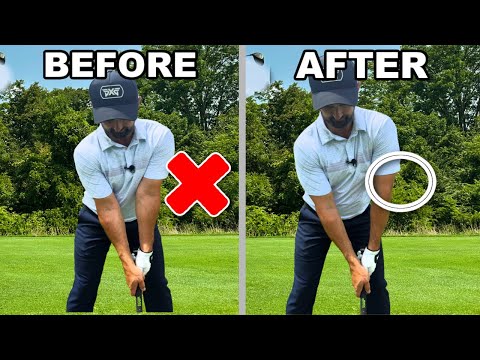
The Simple Golf Arm Position at Address That Cures a Slice and Strike
Most golfers who struggle with a weak slice or thin, glancing contact assume they have an athletic problem.
They tell themselves:
-
"I must not be flexible enough anymore."
-
"I'm pulling across it because my hips are too slow."
-
"I need to figure out how to shallow the club on the way down."
The truth is, that is absolute nonsense.
A golf swing takes roughly one second. If you are standing over the ball trying to micromanage your downswing path, calculate hip clearance, and manipulate the clubhead into position, you are setting yourself up for failure before you even start.
Real, consistent ball striking does not come from mid-swing heroics. It comes from setting up your body so that the correct motion happens automatically - without tension, without strain, and without conscious manipulation.
If you are fighting a slice, losing distance, or battling inconsistent contact, this single adjustment to your arm position at address will transform how your club moves through the ball.
The "Connection" Trap That Forces an Over-The-Top Swing
Every golfer has been told to "stay connected."
You take your grip, pin your elbows tight against your ribs, squeeze your forearms together, and try to tuck your lead arm deep across your chest.
It feels controlled. It feels tight.
It is also the exact reason you come over the top.
When you tuck your lead arm in and squeeze your elbows toward each other, you force your lead shoulder into internal rotation. Even if your chest appears square to the target line, that tucked arm pre-sets your swing path to wipe across the ball from out-to-in.
From that pinched, restricted position, your natural athleticism is completely trapped:
-
You are forced to cast: Because your arms have nowhere to go, your body instinctively thrusts toward the ball or cuts across the target line.
-
You lose your swing radius: Pinning your arms collapses your width, robbing you of effortless speed and forcing you to flip your hands at impact to save the shot.
-
You compensate mid-swing: You try to steer the club outward to "swing to right field," which only introduces more tension and causes weak, glancing contact.
You do not need to learn a complex downswing trick to fix this. You simply need to align your arms correctly before the swing ever begins.
The Pro Arm Alignment: Set the Path Before You Swing
Look at elite ball strikers like Henrik Stenson or Bryson DeChambeau. They do not fight to manipulate the club during the downswing. They do the heavy lifting at address so the club tracks naturally on the correct path.
Here is the exact setup adjustment to make on your very next shot:
1. Let Your Arms Rest Naturally On Top of the Chest
Do not pinch your upper arms into the sides of your ribs. Allow your arms to hang naturally from the shoulder sockets, resting comfortably on top of your chest rather than wrapped around it.
2. Rotate the Lead Elbow Outward Toward the Target
Instead of tucking your lead elbow inward against your torso, subtly rotate your lead forearm and elbow outward so the crease of your elbow points slightly away from you and the elbow bone points toward the target.
This single adjustment opens your shoulder socket into external rotation. It feels as though your elbows have natural width and breathing room between them rather than being glued together.
3. Maintain the Structure and Let the Club Track
When you set up with your lead arm positioned this way, your hands naturally settle slightly forward, setting you up for clean, ball-first turf compression.
From here, you no longer have to "try" to shallow the shaft or force an inside path. Because the lead arm is preset correctly, the club naturally travels back on plane, maintains wide radius without straining your joints, and swings down from the inside with zero manipulation.
It turns the swing into a simple, free-flowing rock of the shoulders - almost like an extended putting motion.
Frequently Asked Questions
Why does rotating my lead elbow out prevent a slice?
When your lead arm is tucked in tight against your body at address, it pre-aligns your swing plane to work across your chest from out-to-in. Rotating the elbow outward establishes external shoulder rotation, which naturally presets an inside-out path without requiring you to steer or manipulate the clubhead during the downswing.
Does this setup change require extra flexibility?
No. In fact, it removes physical strain. Squeezing your elbows together and trying to stay artificially "connected" locks up your upper back and shoulders. Allowing your arms to rest naturally with soft elbow rotation creates room for your body to move smoothly, making it ideal for golfers looking to eliminate swing tension.
Can I use this arm position for all clubs?
Yes. This setup mechanic creates consistent low-point control and shaft lean with your irons, and it establishes the exact same stable swing radius for your fairway woods and driver.
Make Golf Feel Easy Again
Golf is hard enough without forcing your body to wrestle through ten different mechanical checkpoints every time you stand over a shot.
When you get your setup right, your swing improves automatically - just like that.
If you want a clear, step-by-step roadmap that strips away the technical noise and gives you a reliable, body-friendly swing from tee to green, take a look at our complete online training:
Take our 2-minute game assessment to find your custom prescription today.
- - - - - - - - - - - - - - - - - - - - - - - - - - - - - - - - - - - - - - - - - -Need an Emergency Swing and Game Reset?
The Simple Golf Reset Kit provides a fast-acting, 5-video protocol to recalibrate your setup, driver, irons, short game, and putting. No complex theories or rigid mechanics - just simple, body-friendly adjustments that get you back to hitting crisp, clean shots on target.
Click Here to Grab The Simple Golf Reset Kit
