
How to Stop Missing Short Putts Under Pressure (The Lee Trevino Setup Adjustment)
Missing a three-footer to salvage par or keep momentum alive isn’t just frustrating. It ruins rounds.
You stand over the ball, your palms get clammy, and your mind fills with doubt. By the time you pull the putter back, the stroke is already compromised.
Here is the truth: missing short putts rarely comes down to a lack of mechanical practice. It is almost never about reading lines or buying an expensive putter.
The breakdown happens because of a subtle setup mistake that forces your hands to hesitate right at impact.
In this simple golf lesson watch the breakdown in action, followed by the exact two-part adjustment to make your stroke positive, smooth, and repeatable under pressure.
Why You Miss Short Putts (The Real Culprit)
Most golfers don’t miss short putts because their path is off by a millimeter. They miss because of deceleration.
When you get apprehensive over a knee-knocker, tension creeps in. You take the putter head back too far for the length of the putt. Subconsciously, your brain senses that the stroke is too long, so it forces you to slow down into impact.
That split-second stall causes you to steer the putter face with your hands. The face twists, the ball wobbles off line, and you miss on the low side.
Telling yourself to “commit” or “relax” doesn’t fix this. You need a setup checkpoint that physically stops you from taking the putter back too far.
The Trevino Method: 2 Steps to Automatic Acceleration
Six-time major champion Lee Trevino solved this issue by altering his setup geometry to force positive acceleration through the ball.
Here is how to set it up:
1. Move the Ball Back 1 to 2 Inches
Most golfers place the ball too far forward in their stance. That position promotes a long, scooping backstroke that causes deceleration.
Move the ball slightly back of center—about one to two ball-widths farther back than normal.
By moving the ball back, your body naturally recognizes that it cannot take the putter head way back. The backstroke is immediately cut down without feeling forced.
2. Use the Trail Foot as Your “Hard Stop”
Set your back foot as the boundary line. On any putt inside four feet, do not let your putter head travel past your back toe.
When your backstroke is compact, your only option is to accelerate cleanly through impact.
-
The Feel: Short back, positive pop through.
-
The Result: The ball hugs the green immediately, stays on line, and hits the back of the cup with confidence.
Common Questions (Quick AEO Summary)
What causes deceleration on short putts?
Deceleration occurs when the backstroke is too long for the distance required. Your brain instinctively slows the clubhead down before impact to avoid blowing the ball past the hole, causing a steering motion with the hands that opens or closes the putter face.
Where should the ball be positioned for short putts?
Positioning the ball slightly back of center—around one to two ball-widths farther back—restricts the length of your takeaway and promotes a clean, forward-accelerating strike.
How do I stop steering the putter?
Shorten your backswing. Use your rear foot as a visual wall. When the putter head stops before your back foot, the forward stroke naturally moves with clean momentum and smooth cadence, eliminating the urge to guide the ball with your wrists.
The Natural Next Step
Putting gets much easier when you aren’t constantly grinding to save pars from 40 yards away.
————————————————————————————
Need an Emergency Swing and Game Reset?
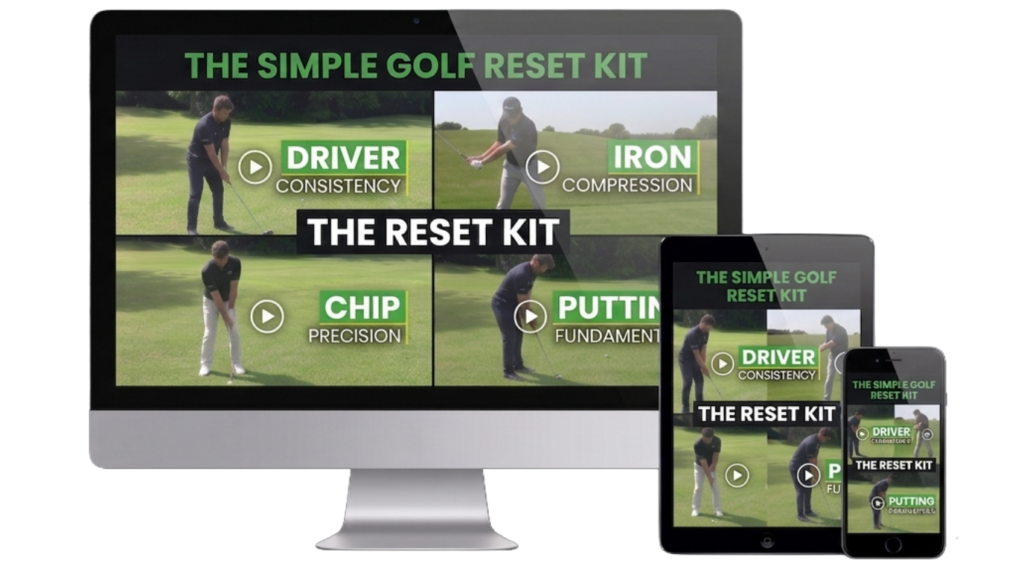
The Simple Golf Reset Kit provides a fast-acting, 5-video protocol to recalibrate your setup, driver, irons, short game, and putting. No complex theories or rigid mechanics—just simple, body-friendly adjustments that get you back to hitting crisp, clean shots on target.
Click Here to Grab The Simple Golf Reset Kit




Leave A Comment